Celebrating 10 Years as McKinney’s "No Anxiety" Dentist!
A patient sits down and says, "I want something that feels permanent, but I do not want to make the wrong choice." That is usually where the real conversation about dental implants pros and cons begins. Not with technology alone, and not with sales language, but with the practical questions that come up when chewing feels uneven, smiling feels self-conscious, or a missing tooth has started to affect daily life.
In a dental office, this discussion is rarely just about replacing a tooth. It is also about comfort, predictability, healing, cost, and whether the treatment fits the mouth that exists today, not the ideal one on a brochure. Implants can be an excellent option for many people, but they are not automatically the best choice for every missing tooth or every patient.
At Starlite Dental, patients can explore dental implant options in a supportive and personalized setting. We work with individuals from McKinney and nearby communities to explain treatment timelines, review candidacy, and discuss the dental implants pros and cons based on each patient’s goals, comfort level, and oral health needs.
A dental implant is a small post, usually made of titanium or a titanium alloy, that is placed in the jawbone to act like an artificial tooth root. After healing, a connector and a crown are attached so the replacement tooth sits above the gumline and functions more like a natural tooth than a removable option would.
This matters because a missing tooth is not only a gap you can see. The root is gone too, and that changes how force travels through the jaw. Bridges and dentures can restore appearance and function in different ways, but implants are unique because they replace the root structure as well as the visible tooth.
The strongest argument in favor of implants is usually stability. A well-planned implant can feel secure during speaking and chewing, and it does not need to be removed for cleaning the way a denture does. For many patients, that sense of normalcy is the real benefit, more than the idea of having something "permanent."
Another major advantage is bone support over time. When a tooth is lost, the jawbone in that area may gradually shrink because it is no longer being stimulated by a root. An implant can help preserve that area of bone better than options that sit above the gums only. That does not mean bone loss stops in every case, but it is one of the most meaningful biological reasons implants are often recommended.
Implants also usually avoid preparing neighboring teeth the way a traditional bridge often does. If the teeth next to the gap are healthy, many dentists see value in leaving them as untouched as possible. That conservative approach can be important in a mouth that may need future dental work later on.
The most obvious drawback is that implants involve surgery. Even when placement is straightforward, it is still a procedure in bone and soft tissue, followed by a healing phase that may take months. For some patients, that timeline feels reasonable. For others, especially when the missing tooth is visible and the replacement needs to happen quickly, the slower pace can be frustrating.
Cost is another real factor. Implants often cost more upfront than bridges or removable dentures, and the total fee may include imaging, extractions, bone grafting, temporary restorations, and the final crown. The number that matters is not the advertised implant price alone, but the full treatment plan.
There are also biological and mechanical risks. An implant may fail to integrate with the bone, meaning the body does not heal around it as expected. In other cases, the implant integrates but later develops inflammation in the surrounding tissue. This can range from mild gum irritation to peri-implantitis, an inflammatory condition around an implant that can lead to bone loss. While many implants do very well for years, they are not maintenance-free.
If fear or dental anxiety is part of the decision, ask about sedation options early in the conversation (learn what is sedation dentistry and the types of sedation). Comfortable, controlled sedation can make surgery and follow-up visits much easier for patients who are worried.
A good candidate usually has enough jawbone to support the implant, healthy gum tissue, and a bite pattern that will not overload the restoration. That said, candidacy is not always obvious from appearance alone. Someone can look healthy and still need imaging because the bone width or height is limited, especially in areas where a tooth has been missing for a long time.
General health matters too. Conditions that affect healing may influence planning and prognosis. Smoking and uncontrolled gum disease are especially important because they can increase the risk of complications. None of this automatically rules out treatment, but it does mean the decision should be individualized and clinically supervised.
One of the more honest parts of the implant conversation is this: wanting an implant and being ready for an implant are not always the same thing. Sometimes the best first step is treating gum disease, improving home care, or rebuilding bone before the implant is placed.
Implants are often presented as the premium option, but premium does not always mean most appropriate. If the teeth next to a missing tooth already need crowns, a restorative dentistry approach with a bridge may be a sensible solution because those teeth are being restored anyway. If multiple teeth are missing and the budget is limited, a partial denture may restore function sooner and at lower cost.
There are also cases where anatomy, health history, or healing priorities make a removable or fixed non-implant option more practical. A patient who wants to avoid surgery, shorten treatment time, or delay major expenses may reasonably choose a bridge or denture. Dentistry works best when the plan fits the person, not when the person is pressured to fit the plan.
| Option | Main Advantages | Main Limitations |
| Dental implant | Supports bone, does not rely on adjacent teeth, feels stable | Higher cost, surgery required, longer healing time |
| Dental bridge | Faster than many implant cases, fixed in place | May require reshaping neighboring teeth, does not replace root |
| Partial denture | Lower upfront cost, replaces several teeth at once | Less stable, removable, may feel bulkier |
| Full denture with implant support | Better retention than a conventional denture | More complex treatment, added surgical steps |
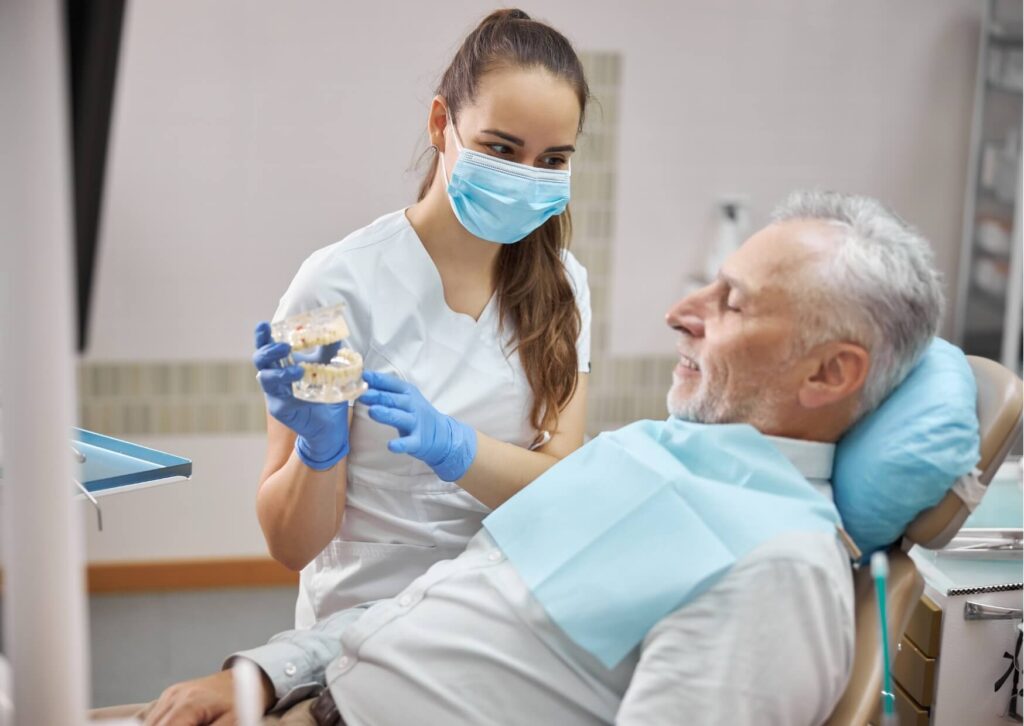
The process usually starts with an exam, dental X-rays, and often a 3D scan called cone beam CT. This helps the dentist or specialist evaluate bone volume, nerve position, sinus anatomy in the upper jaw, and the angle needed for safe placement. If a tooth is still present but cannot be saved, the timing of extraction and implant placement becomes part of the plan.
After placement, the implant needs time to integrate with bone. This is called osseointegration, which means the bone heals directly against the implant surface. During this phase, the area may look quiet from the outside while important healing is still happening below the gums. Once the implant is stable, the final crown or other restoration is made and attached.
Surgical steps such as extractions or grafting are often part of the pathway to a reliable result; in those cases, working with an experienced oral surgery team helps set clear expectations for treatment and recovery.
For some patients, the breakthrough moment is not dramatic. It is the first meal that feels balanced again, or the first photograph where the missing space is no longer the focus. That quiet return to normal function is often what people were hoping for all along.
Some soreness, swelling, and mild bleeding can happen after implant surgery, especially in the first few days. Those symptoms often improve gradually. What deserves closer attention is pain that worsens instead of easing, swelling that spreads, drainage with a bad taste or odor, a fever, or an implant area that feels increasingly loose.
A crown on an implant can also feel high, awkward, or difficult to clean if the bite or contour is not ideal. Persistent bleeding around the implant, gum recession, or tenderness during chewing should be evaluated rather than watched indefinitely. Severe swelling, trouble swallowing, trouble breathing, or rapidly spreading infection symptoms require urgent medical or dental attention.
Not every symptom means the implant is failing. Bite problems, gum inflammation, and temporary healing issues can have different causes. Still, persistent or worsening symptoms should be assessed by a dentist promptly.
One common misconception is that implants last forever without much care. In reality, they need consistent cleaning, routine dental follow-up, and monitoring of the surrounding gum and bone. The implant itself may remain stable for many years, while the crown, screw, or surrounding tissue may still need maintenance or repair over time.
Daily care matters because plaque can collect around implants just as it does around natural teeth. The tissues around implants do not respond exactly the same way as tissues around a natural root, which is one reason inflammation should be taken seriously early. Patients who do best long term usually treat the implant as something valuable that still needs attention, not as a problem that has been permanently erased.
A useful implant consultation is not only about whether placement is possible. It should also clarify whether the expected benefit is worth the cost, healing time, and complexity in that specific case. Asking good questions often leads to better decisions than simply asking for the "best" option.
Consider asking:
Replacing a tooth is not about chasing perfection. The goal is to restore function, protect health, and make daily life feel easier.
Understanding the dental implants pros and cons is an important step toward making a decision that supports your comfort, oral health, and long-term quality of life.
Starlite Dental provides personalized guidance, detailed evaluations, and treatment recommendations tailored to patients’ specific needs and goals. Whether you are missing one tooth or exploring full-mouth restoration options, our team can help you understand what to expect at every stage of care.
Call (214) 504-0500 today to schedule your consultation and learn whether dental implants are the right solution for your smile. We welcome patients from McKinney and nearby areas, and can discuss sedation and payment options to make care easier.
Sometimes, but not always. Implants can preserve bone and avoid using adjacent teeth for support, while bridges may be faster and more practical in some cases. The better choice depends on bone, neighboring teeth, bite forces, health history, and budget.
Many implants function well for years, and some last much longer, but longevity varies. Gum health, smoking, bite stress, home care, and regular dental maintenance all affect outcomes.
Discomfort is common after placement, but many patients describe it as manageable and temporary. Severe or worsening pain is not typical and should be reported to the treating dentist.
No. Some patients need gum treatment, bone grafting, or medical clearance before implant treatment is considered. A proper exam and imaging are needed to determine candidacy.
The answer varies, but the most common concerns are cost, surgery, healing time, and the fact that complications can still happen. A balanced discussion of benefits and risks is essential before moving forward.